


 Deutsch
 English
 Italiano
Process guide: which manufacturing process is right for your part?
The right manufacturing process depends on the part: on the material, the required properties, the geometry, the quantity and the requirements for surface and accuracy. Only the interplay of these factors determines whether 3D printing, CNC machining or a casting process makes technical and economic sense.
On the PROTIQ Marketplace, you will find more than 12 processes – from laser sintering and laser melting of metal to injection molding. This page helps you with the preselection. After uploading, you choose the process and material and usually see the price and production time right away; the system automatically checks whether the part fits into the build space. If you are unsure, contact us.
Process selection at a glance
- Material groups
- Plastics, metal, ceramics and glass
- Range
- more than 160 materials and more than 12 processes, additive and conventional
- Key criteria
- Material, requirements, geometry, quantity, surface and accuracy
- Price
- usually directly in the configurator, otherwise via price request
- Advice
- in person from the PROTIQ team
Process finder
Which process suits your part?
Answer up to four questions. The matching processes move to the top, and our assessment of your selection appears above them.
1 Which material?
2 What is the most important requirement?
This requirement does not match the selected material.
3 What is the geometry like?
4 What quantity?
Our assessment
Make your selections above. This is where you will see what matters for your choice.
Our assessment
Single part or prototype
Without tooling, 3D printing and CNC machining produce parts directly from your 3D data. If the prototype should look like the later production part, resin-based processes with a smooth surface are a good fit.
Our assessment
Small batch
3D printing remains cost-effective without tooling, and many parts are produced together in one build. Vacuum casting replicates a master model in a silicone mold.
Our assessment
High volume
For simple parts, a tooling-based process such as injection molding is usually the most cost-effective. 3D printing also pays off in series production if the part is complex, for example with internal channels or lattice structures, or if every part is different. Specify the geometry in step 3 to narrow down the selection.
Our assessment
Simple parts in high volumes
A tooling-based process is usually the most cost-effective here: injection molding for plastics, milling or turning for simple metal parts. 3D printing can bridge the time until the tool is ready or cover quantities for which a tool does not yet pay off.
Our assessment
Complex parts in high volumes
If a tool cannot reproduce the geometry, or only with great effort, 3D printing is often the best choice even for high volumes. In the powder bed, many parts are produced together in one build space. It is often worth redesigning the part for this and combining several functions in one part.
Our assessment
Every part different
For individual parts such as orthopedic aids, dental splints or personalized products, 3D printing does not need a new tool for each variant. That is why it is the first choice here, even for high volumes.
Our assessment
Large parts
How large a part can be depends on the provider’s machine. When you upload, the configurator automatically checks whether it fits into the build space. In laser sintering, parts that are too large can also be split and joined after printing.
Our assessment
Very small, delicate parts
Fine details are achieved with resin-based processes, and for metal and ceramics with LMM and LCM. You will find the minimum wall thicknesses on the process pages.
Our assessment
Tight tolerances
CNC machining is usually the most accurate. Printed parts can be machined on functional surfaces. This lets you combine a complex geometry with tight fits.
Our assessment
Heat resistance
The heat deflection temperature of a plastic is not a continuous service temperature. For permanently high temperatures, metal, ceramics or glass are an option.
Our assessment
Transparent
3D-printed glass is transparent, temperature-resistant and does not yellow. Parts made of transparent resins are usually sanded, polished or clear-coated for a clear appearance.
Our assessment
Conductive or dissipative
For electronics, there are dissipative plastics such as PA11 ESD in laser sintering or ABS-ESD in FDM. Copper from laser melting is suitable for high electrical conductivity.
Our assessment
Flame retardancy
The UL 94 classification applies to the wall thickness stated in the data sheet. Whether the finished part meets the requirements must be checked on a case-by-case basis.
Our assessment
Food contact or medical
Some materials have conformity information, for example food-grade PA11 or PA12 in laser sintering or FDM materials with information according to EU 10/2011 or ISO 10993. Whether the finished part is suitable depends on design, processing and use and must be checked on a case-by-case basis.
of 15 processes match your selection Matching processes are shown first, the others are grayed out.
The finder is a guide and does not replace a case-by-case review. After uploading, you can see which materials are currently available in the configurator. Nothing suitable? Contact us.
Processes compared
How do the 3D printing processes differ?
The 3D printing processes on the PROTIQ Marketplace differ mainly in material, surface and intended use. The table summarizes the most important differences; you can find details on the process pages.
| Process | Materials | Strengths | Keep in mind |
|---|---|---|---|
| Laser sintering (SLS) | PA12, PA11, PA6, TPU, PP and others | resilient, no support structures, complex geometries | surface slightly rough, matte |
| Multi Jet Fusion (MJF) | PA12, PA11, PP, TPU | functional parts without support structures | base color grayish by default |
| Stereolithography (SLA) | synthetic resins (photopolymers) | smooth surfaces, fine details | support structures required |
| Hot Lithography (HL) | high-viscosity photopolymers | high-performance resins, walls from 0.3 mm | support structures usually required |
| CLIP / DLS | epoxy, PU and methacrylate resins, elastomers | robust and elastic parts, smooth surface | support structures required |
| Material Jetting (PolyJet / MultiJet) | currently silicone-like materials, Shore A 35 and A 65 | soft parts, 30 µm layer thickness | support material required |
| Binder Jetting (BJT) | PMMA-based plastics | no support structures, easy to machine | surface slightly rough |
| Fused Deposition Modeling (FDM) | thermoplastics, including flame-retardant, fiber-reinforced, conductive | special materials, larger parts | layer lines visible, properties depend on direction |
| Laser melting (SLM) | steel, aluminum, titanium, copper, brass, zinc alloy and others | metal functional parts, internal channels | support structures required |
| Lithography-based Metal Manufacturing (LMM) | stainless steels, e.g. 316L and 17-4PH | small, delicate parts, smooth surface | small parts only |
| Ceramics (LCM) | technical ceramics, e.g. ATZ | hard, temperature-resistant, electrically insulating | small parts, brittle |
| Glass (LGM) | quartz glass | transparent, usable up to 1,000 °C | wall thickness 0.8–5 mm, tolerances ± 250 µm (uncoated) |
Overview based on the process pages and datasheets on the PROTIQ Marketplace; no guaranteed properties. The supplier’s information in the ordering process or in the quote is authoritative.
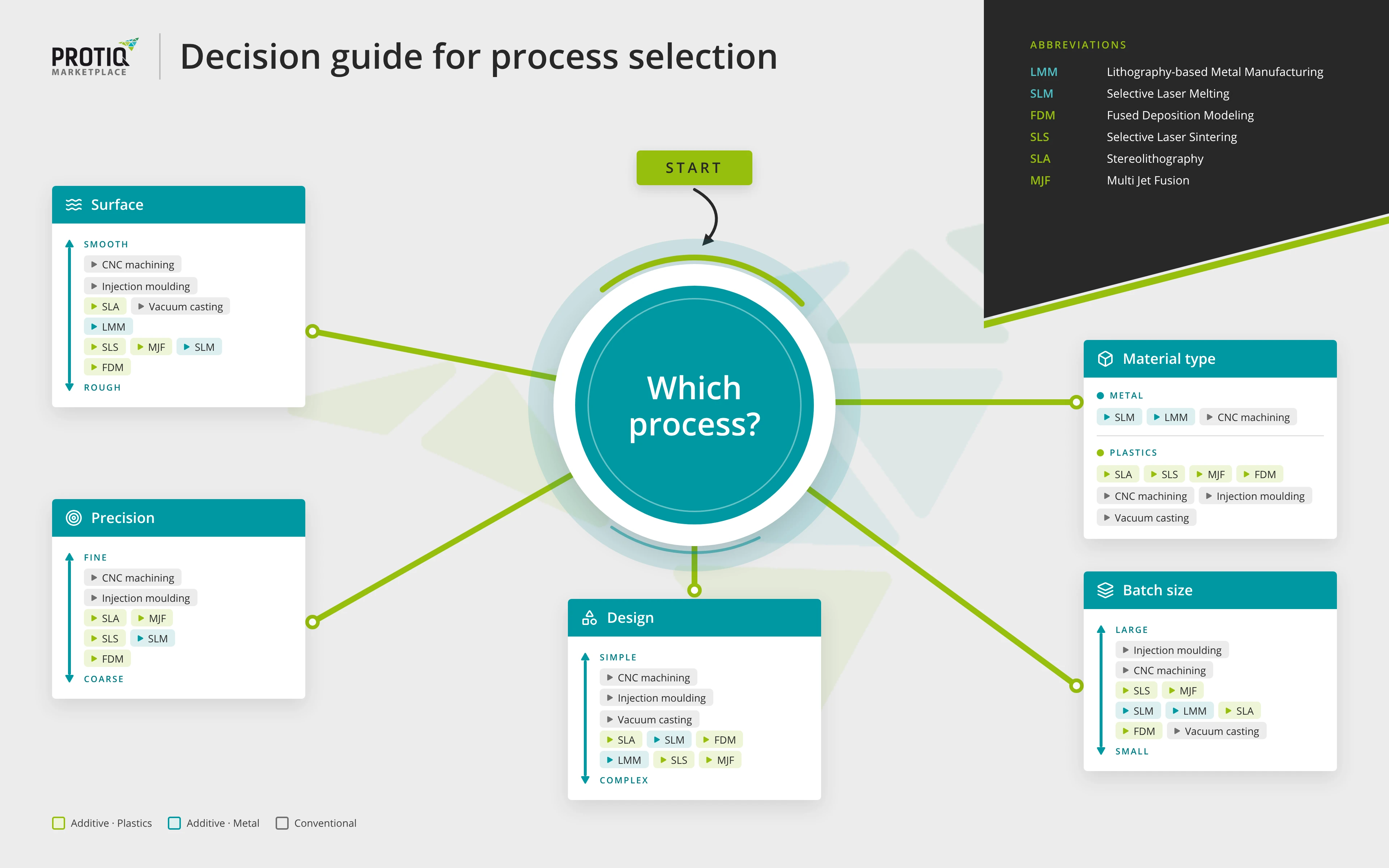
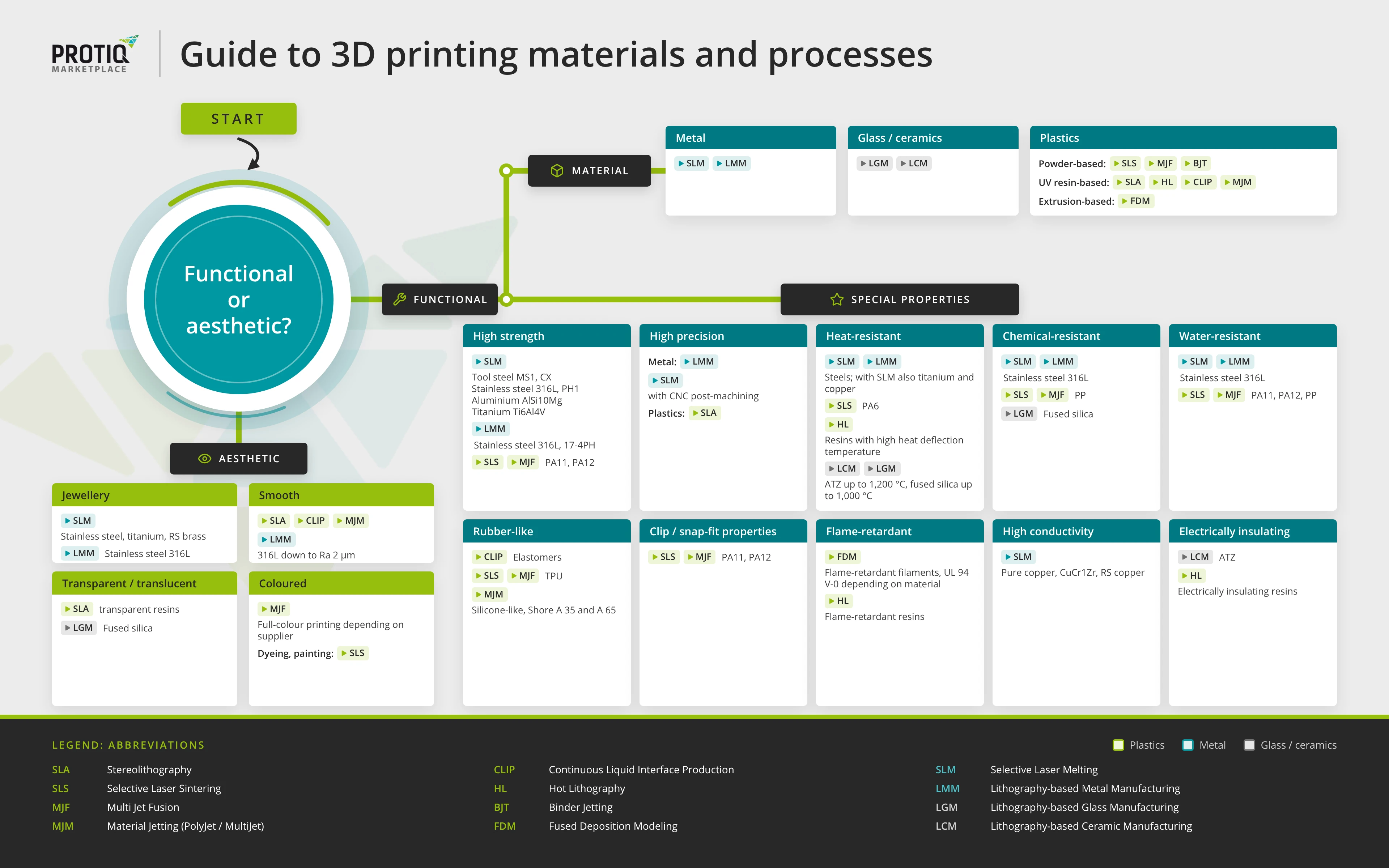
Overview graphics to enlarge
Both graphics summarize the selection at a glance and serve as a rough guide. Click on a graphic to open it in full size.
 Enlarge
 Enlarge
3D printing or conventional?
When is a conventional process the better choice?
3D printing plays to its strengths with complex geometries, prototypes and small to medium quantities because no tooling is required. Simple geometries with tight tolerances can often be milled or turned more economically, while large quantities are better suited to injection molding.
| 3D printing | CNC machining | Injection molding | Vacuum casting | |
|---|---|---|---|---|
| Tooling | not required | not required | mold or tool required | silicone mold from master model |
| Typical quantity | single part to small series, depending on the process also series | single part to medium series | large quantities | prototypes and small series |
| Geometry | complex, including internal channels | rather simple, prismatic or rotationally symmetrical | limited by tool and demoldability | limited by mold and demoldability |
| Tolerances | depends on the process | tight tolerances possible | tight, depending on the tool | depend on master model and casting resin |
- Zamak 5 in 3D printing For zinc parts in large quantities, die casting with tooling is cost-effective. Prototypes and small series made of the die-casting material Zamak 5 are produced by laser melting – without a die-casting tool.
Process groups
What groups of 3D printing processes are there?
3D printing processes can be distinguished by how the material is solidified. This results in the typical strengths and limits of each group.
Powder bed
A thin layer of powder is spread out and selectively solidified – by a laser (SLS, SLM), by a printed fusing agent together with infrared light (MJF) or by a binder (Binder Jetting). The surrounding powder supports plastic parts, whereas support structures are required for laser melting of metal.
Photopolymerization
A liquid, light-curing resin is cured with light – layer by layer (SLA, Hot Lithography) or continuously (CLIP). SLA and CLIP deliver comparatively smooth surfaces and fine details; Hot Lithography processes heated, high-viscosity high-performance resins.
Lithography followed by sintering
A mixture of metal, ceramic or glass particles and a light-curing binder is exposed to light. The green part is then debound and sintered – resulting in parts made of metal, ceramics or glass.
Material jetting and extrusion
In material jetting, fine droplets are applied and cured. In extrusion (FDM), a molten filament is deposited track by track.
Multi Jet Fusion, PolyJet, MultiJet, CLIP, Digital Light Synthesis and Hot Lithography as well as other names mentioned are trademarks or names of their respective owners. They are mentioned only to describe the processes.
↑ Back to overviewFAQ
Frequently asked questions about choosing a process
How do I find the right manufacturing process for my part?
First clarify the material and requirements, then geometry, quantity, surface and accuracy. The process finder on this page shows suitable processes for your input. After uploading your file, you choose the process and material in the configurator and usually see the price and production time right away.
Does the PROTIQ Marketplace only offer 3D printing?
No. In addition to numerous 3D printing processes, you will also find CNC machining, injection molding and vacuum casting as well as various finishing options.
When is 3D printing cheaper than conventional manufacturing?
Often for prototypes, spare parts, customized parts and small quantities, because no tools or molds are required. For large quantities, injection molding or die casting is usually more economical despite the tooling costs.
When should I choose 3D printing instead of CNC milling?
3D printing makes sense for complex geometries, internal channels, function integration or individual adaptations. CNC machining plays to its strengths with simple geometries and tight tolerances.
What is the difference between SLS and MJF?
Both processes produce plastic parts in a powder bed without support structures. In laser sintering, a laser melts the powder; in Multi Jet Fusion, a printed fusing agent does so together with infrared light. MJF parts are grayish by default.
Which 3D printing processes are available for metal?
On the PROTIQ Marketplace, selective laser melting (SLM) is the obvious choice for metal functional parts. For small, delicate stainless steel parts, Lithography-based Metal Manufacturing (LMM) is suitable.
Why do prices differ between processes?
The price depends on factors such as the process, material, part volume, geometry, quantity and finishing. That is why the same part can cost different amounts depending on the process. In the configurator, you can compare the available offers directly.