


 Deutsch
 English
 Italiano
Plastics for laser sintering (SLS): polyamides, TPU and more
Plastics in laser sintering
Which plastics are available for laser sintering?
In selective laser sintering (SLS), a laser fuses plastic powder layer by layer into solid parts – without support structures. The most commonly processed materials are polyamides such as PA12 and PA11: stable over the long term, mechanically durable and resistant to many chemicals.
PROTIQ manufactures SLS parts in its own production facility in Blomberg, using materials such as PA12, PA11, PA11 ESD, glass bead filled and flame-retardant PA12, PA 6X and TPU. Other manufacturers on the PROTIQ Marketplace add further materials and colors to the range.
Which plastic is right depends on what your part needs to do: stiffness, toughness, temperature resistance, flame retardancy, flexibility or electrical dissipation.
SLS plastics at a glance
- Process
- Selective laser sintering (SLS)
- Materials at PROTIQ
- PA12, PA11, PA 6X, TPU and more
- Minimum wall thickness
- 1.0 mm
- Tolerance
- ± 0.7 %, at least ± 0.1 mm
- Surface
- slightly rough and matte
- Support structures
- not required
- Color
- base color depending on material; can be dyed and painted
Information according to PROTIQ data sheets. Other manufacturers state their values in their respective offers.
Material groups
Which groups of plastics can you choose from?
For laser sintering, there are standard polyamides, filled and flame-retardant grades, high-temperature plastics and flexible TPU.
Filled and flame-retardant
Glass bead filled PA12 for greater stiffness, PA 2210 FR with flame retardancy.
Learn morePA12
PA12: the standard in laser sintering
Polyamide 12 is the standard material in laser sintering: a good balance of strength and toughness, dimensionally accurate and easy to post-process.
PA12 is suitable for prototypes, functional parts, housings, holders and small series. The parts are white, can be dyed or painted and can also be printed in one piece with moving elements. With a tensile modulus of 1,700 MPa and a tensile strength of 45–50 MPa, PA12 is highly versatile; its melting point is 176 °C.
By arrangement, PROTIQ can thicken areas of your 3D model that are too delicate and thus make them printable for laser sintering.
↑ Back to overview
PA11
PA11 and PA11 ESD: tough and dissipative
PA11 is made from castor oil, a renewable raw material. Compared with PA12, it is tougher and more ductile.
- PA11: elongation at break of 31–45 % – for parts that are allowed to deform without breaking, such as snap-fit connections, clips or hinges.
- PA11 ESD: dark gray, electrically dissipative grade with a surface resistance of approx. 104 Ω. It is suitable for parts that need to dissipate electrostatic charge, for example holders and fixtures in electronics manufacturing.
Filled & flame-retardant
Glass bead filled and flame-retardant PA12
Fillers and additives modify the properties of PA12 in a targeted way: glass beads make it stiffer, flame retardants make it less flammable.
- PA12 GF (glass bead filled): tensile modulus of 2,800–3,200 MPa and heat deflection temperature of up to 157–163 °C at 0.45 MPa – for stiff, dimensionally stable parts.
- PA 2210 FR (flame-retardant): meets UL 94 V-0 at 3.0 mm and UL 94 HB at 0.75 mm wall thickness. The material has also passed further tests on flammability, smoke density and toxicity; we will provide the certificates on request.
The availability of filled materials may vary. You can see which grades can currently be ordered in the configurator.
↑ Back to overviewHigh-temperature & flexible
PA 6X, PEKK and TPU 80A
For higher temperatures, there is polyamide 6X; for flexible parts, there is the thermoplastic polyurethane TPU 80A.
- PA 6X: melting point of 215 °C and heat deflection temperature of up to 195 °C at 0.45 MPa, tensile strength of 54–60 MPa – for parts in warm environments.
- PEKK: high-performance plastic with a melting point of 298 °C. PEKK and PEEK are available on request.
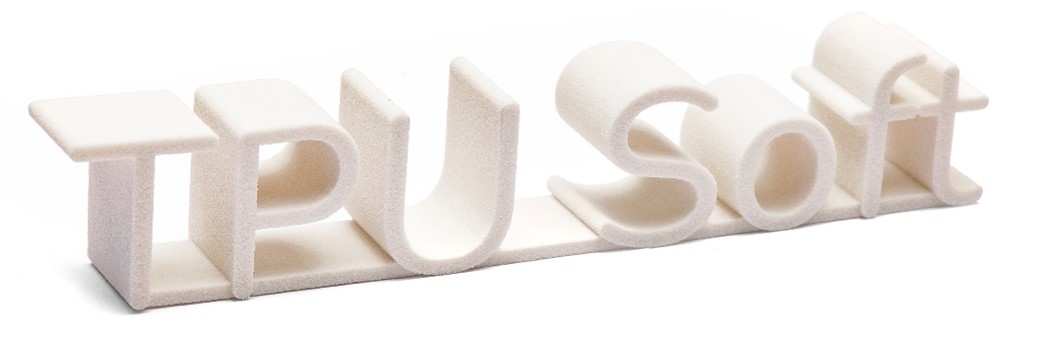
- TPU 80A: rubber-like with a Shore hardness of 80 A and an elongation at break of 300–550 % – for dampers, seals, grips or flexible protective caps.
Properties
What are the properties of SLS plastics?
The table shows the most important properties of the plastics from PROTIQ production. Where a range is given, the value depends, among other things, on the position of the part in the build chamber.
Please select at least one material.
| Property | PA12 | PA12 GF | PA 2210 FR | PA 6X | PA11 | PA11 ESD | TPU 80A | PEKK (on request) |
|---|---|---|---|---|---|---|---|---|
| Mechanical and thermal properties | ||||||||
| Color | white | white/grayish | white/beige | white/beige | white | dark gray | white | beige/brownish |
| Densityg/cm³ | 0.9–1.0 | 1.2–1.3 | 1.06 | 1.00–1.04 | 1.02 | 1.07 | 1.1–1.2 | 1.29 |
| Tensile modulusMPa | 1,700 | 2,800–3,200 | 2,200–2,500 | 2,200–2,500 | 1,100–1,250 | 1,550–2,300 | 55 | 3,900–4,000 |
| Tensile strengthMPa | 45–50 | 45–53 | 38–46 | 54–60 | 45–46 | 47–55 | 5.5–8 | 60–81 |
| Elongation at break% | 15 | 5–9 | 3–7 | 15–25 | 31–45 | 22–31 | 300–550 | 1.6–2.3 |
| HardnessShore | 75 D | 80 D | 79 D | 78 D | – | – | 80 A | – |
| Melting point°C | 176 | 176 | 185 | 215 | 203 | 204 | 95 | 298 |
| Heat deflection temperature 1.80 / 0.45 MPa°C | 70 / 154¹ | 96–101 / 157–163 | – | 80 / 195 | 76 / 176 | 111 / 186 | – | – |
| Electrical properties | ||||||||
| Volume resistivityΩ·cm | 1013–1015 | – | – | – | – | 2.3 · 106 (XY), 2.1 · 1010 (Z) | – | – |
| Surface resistanceΩ | – | – | – | – | – | 1.3 · 104 (XY), 3.4 · 104 (Z) | – | – |
| Dielectric strengthkV/mm | 92 | – | – | – | – | – | – | – |
Values from the PROTIQ material data sheet (as of 08/2026), without the stated deviations; not guaranteed properties. The mechanical properties may vary depending on the orientation of the test specimens (X, Y, Z) and the exposure parameters. ¹ At 0.65 MPa. The data sheet in the ordering process is binding.
Selection
Which SLS plastic is right for my application?
PA12 is a good choice for most parts. If your application has special requirements, this overview will help.
| Requirement | Suitable materials |
|---|---|
| Prototypes, functional parts, small series | PA12 |
| Toughness, snap-fit connections, hinges | PA11 |
| Dissipation of electrostatic charge | PA11 ESD |
| High stiffness and dimensional stability | PA12 GF |
| Flame retardancy | PA 2210 FR |
| Higher temperatures | PA 6X; PEKK on request |
| Flexible, rubber-like parts | TPU 80A |
In addition to the materials from PROTIQ production, other manufacturers on the PROTIQ Marketplace offer SLS plastics – depending on the offer, for example PA6, polypropylene, filled polyamides or grades for food contact applications. You can see which materials are currently available in the configurator after uploading your file. An alternative powder bed process is Multi Jet Fusion (MJF).
↑ Back to overviewGood to know
What should I consider with SLS plastics?
Material and design go hand in hand. These points will help you get the most out of the right material.
- Wall thicknessPlan walls of at least 1.0 mm. By arrangement, PROTIQ can thicken areas that are too thin.
- Large partsPROTIQ can split parts that do not fit into the build chamber and join them after printing.
- Color and surfaceSLS parts are slightly rough and matte. They can be dyed, painted or smoothed.
- Test certificatesCertificates, for example on fire behavior, apply to the wall thickness stated in the data sheet. Please check the suitability of the finished part for your application.
Ordering
How do I order parts made of SLS plastic?
You order SLS parts directly on the PROTIQ Marketplace – with a live price and a free choice of manufacturer.
- Upload 3D fileUpload your 3D model. The system automatically checks whether the part fits into the build chamber.
- Choose the materialChoose the plastic and, if required, the color and finish.
- Compare offersCompare prices and production times and choose your manufacturer yourself.
- OrderOrder directly online or download a binding PDF quote.
FAQ
Frequently asked questions about plastics for laser sintering
Which plastics are used in laser sintering?
Laser sintering mainly processes polyamides, above all PA12 and PA11. There are also filled and flame-retardant grades, high-temperature plastics such as PA 6X and flexible materials such as TPU. You can see which plastics are currently available on the PROTIQ Marketplace in the configurator after uploading your file.
What is the difference between PA12 and PA11?
PA12 is the standard material in laser sintering: a good balance of strength and stiffness, and dimensionally accurate. PA11 is made from castor oil and is tougher – its elongation at break is 31–45 %, compared with approx. 15 % for PA12. This is why PA11 is often the better choice for snap-fit connections and parts subject to impact.
Which SLS plastic is flexible?
TPU 80A is rubber-like with a Shore hardness of 80 A and an elongation at break of 300–550 %. It is suitable for dampers, seals, grips or flexible protective caps.
Are there flame-retardant plastics for 3D printing?
Yes. PA 2210 FR is a flame-retardant PA12 that meets UL 94 V-0 at 3.0 mm and UL 94 HB at 0.75 mm wall thickness. The test certificates apply to the stated wall thickness; the suitability of the finished part must be checked for the respective application.
Which SLS plastic can withstand high temperatures?
PA 6X achieves a heat deflection temperature of up to 195 °C at 0.45 MPa and has a melting point of 215 °C. For even higher requirements, PEKK and PEEK are available on request.
Are there dissipative plastics for laser sintering?
Yes. PA11 ESD is electrically dissipative with a surface resistance of approx. 104 Ω. It is suitable for parts that need to dissipate electrostatic charge.
What colors are SLS parts available in?
The base color depends on the material – PA12, for example, is white and PA11 ESD is dark gray. SLS parts can be dyed or painted. You can see which colors are offered in the configurator.
How thin can the walls of SLS parts be?
According to PROTIQ data sheets, the minimum wall thickness is 1.0 mm. By arrangement, PROTIQ can thicken areas that are too thin.