


 Deutsch
 English
 Italiano
Glass for 3D printing: fused silica parts
Glass in 3D printing
What glass is available for 3D printing?
Glass 3D printing produces parts made of real fused silica. A liquid composite of glass powder and light-curing binder is exposed layer by layer, then debound and sintered into dense, transparent glass.
On the PROTIQ Marketplace, glass 3D printing is based on Glassomer technology. The sintered fused silica has a purity of 99.9 % and does not differ chemically or physically from commercially available fused silica.
Because the shape is created by 3D printing, complex geometries – including channels and cavities with openings – can be produced without tooling. This is suitable for prototypes, single parts and small batches that could only be produced conventionally from glass with great effort.
Glass at a glance
- Process
- Lithography-based Glass Manufacturing (LGM)
- Material
- Fused silica, 99.9 %
- Max. temperature
- 1,000 °C
- Max. part size
- 164 × 90 × 150 mm
- Wall thickness
- 0.8 to 5 mm
- Tolerances
- ± 250 µm uncoated, ± 500 µm coated
- Quantity
- Single part to small batch
Values from the datasheet on the PROTIQ Marketplace (as of 11/2024).
Fused silica
Fused silica from the 3D printer
Fused silica consists almost entirely of silicon dioxide. It is hard, temperature-resistant, resistant to most acids and solvents and hardly expands when heated.
The sintered parts are transparent and stay clear permanently without yellowing – unlike many transparent plastics. However, hydrofluoric acid and strong alkalis attack fused silica.
The parts are manufactured using Glassomer technology.
↑ Back to overview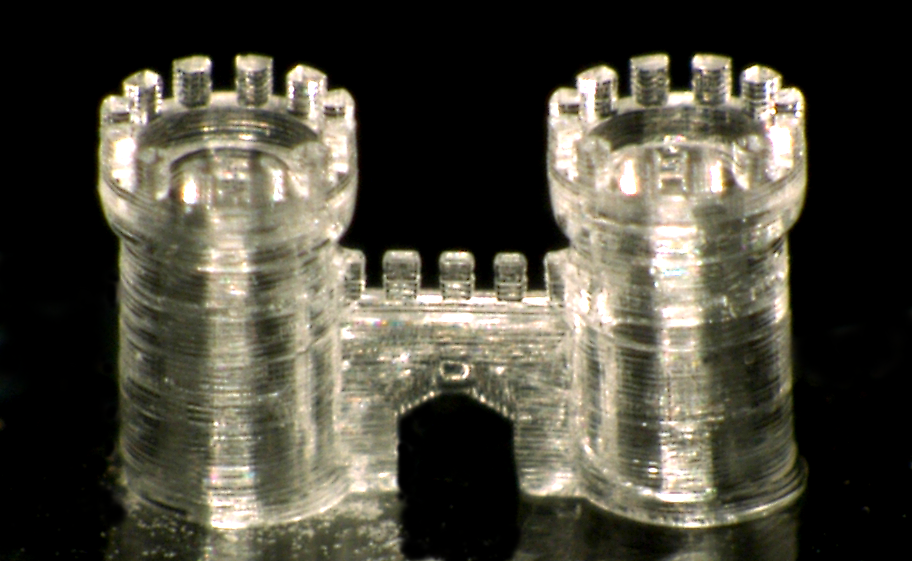
Properties
What properties does 3D-printed glass have?
3D-printed fused silica combines the design freedom of 3D printing with the typical properties of fused silica.
- Real fused silicaAfter sintering, the part consists of fused silica with a purity of 99.9 %.
- TransparentThe parts are transparent. A coating smooths the surface and further increases transparency.
- Temperature-resistantThe maximum service temperature is 1,000 °C.
- Hardly any thermal expansionAt 0.52 · 10−6/K, the coefficient of thermal expansion is close to zero.
- HardThe Vickers hardness is 980 HV.
- Chemically resistantFused silica is resistant to most acids and solvents.
Technical data
What technical data does 3D-printed fused silica have?
The table shows the most important technical data of the sintered fused silica.
| Property | Value |
|---|---|
| Glass type / purity | Fused silica / 99.9 % |
| Density | 2.2 g/cm³ |
| Vickers hardness | 980 HV |
| Flexural strength | 115 MPa |
| Coefficient of thermal expansion | 0.52 · 10−6/K |
| Max. temperature | 1,000 °C |
Values from the datasheet on the PROTIQ Marketplace (as of 11/2024); they do not constitute guaranteed properties. The values depend on process control and part geometry. The datasheet in the ordering process is binding.
↑ Back to overviewSurface
Coated or uncoated?
For glass parts, you choose between an uncoated and a coated surface. The choice depends on whether dimensional accuracy or appearance is more important.
| Uncoated | Coated | |
|---|---|---|
| Tolerances (X, Y, Z) | ± 250 µm | ± 500 µm |
| Surface | printed layers remain visible | smooth |
| Transparency | transparent | higher transparency |
| Suitable for | dimensionally accurate parts | parts with high visual requirements |
Tolerances may change depending on part geometry.
↑ Back to overview
Applications
What is 3D-printed glass suitable for?
Glass 3D printing is worthwhile wherever complex shapes are needed in a transparent, temperature-resistant and chemically resistant material.
- Microfluidics and laboratory technology: parts with internal channels, for example for small-scale chemical reactors.
- Optics: compact optical components and prototypes.
- High-temperature applications: transparent parts that must withstand high temperatures.
- Design and jewelry: delicate glass objects that can hardly be produced conventionally.
Glass or alternative?
When is glass the right choice?
Fused silica is the first choice when transparency is combined with temperature or chemical resistance. For other requirements, there are suitable alternatives.
| Requirement | Recommendation |
|---|---|
| Transparency and temperatures up to 1,000 °C | Fused silica |
| Transparency and chemical resistance | Fused silica |
| Transparent prototype at room temperature | RS Clear in stereolithography |
| High hardness and strength, no transparency required | Technical ceramics using the LCM process |
| Very tight tolerances | Fused silica with post-processing or conventional glass processing |
Good to know
What should I consider with glass parts?
Glass places its own demands on the design. These points help with planning.
- Wall thicknessPlan walls between 0.8 and 5 mm. Bulkier areas should be split up or hollowed out.
- Holes and channelsHoles are possible from a diameter of 0.7 mm. Cavities need openings.
- Part sizeParts can be up to 164 × 90 × 150 mm in size.
- Optical requirementsFor optical applications with high surface requirements, please check suitability with us in advance.
Ordering
How do I order glass parts?
You order glass parts directly on the PROTIQ Marketplace.
- Upload 3D fileUpload your 3D model. The system automatically checks whether the part fits into the build volume.
- Choose categorySelect the ceramics/glass material category, then a coated or uncoated surface. The datasheet is linked to the offer.
- Check the offerCheck the price and production time of the offer.
- OrderOrder directly online or download a binding PDF quote.
FAQ
Frequently asked questions about glass in 3D printing
Can glass be 3D printed?
Yes. Glass 3D printing produces parts made of real fused silica: a liquid composite of glass powder and binder is exposed layer by layer, then debound and sintered into transparent glass. On the PROTIQ Marketplace, the process is based on Glassomer technology.
What glass is used in 3D printing?
The PROTIQ Marketplace offers fused silica with a purity of 99.9 %. It is transparent, can be used up to 1,000 °C and is resistant to most acids and solvents.
Is 3D-printed glass transparent?
Yes. The sintered parts are transparent. Without coating, the printed layers remain visible on the surface; a coating smooths the surface and increases transparency.
How accurate are 3D-printed glass parts?
Tolerances are ± 250 µm for uncoated and ± 500 µm for coated parts. Tighter tolerances require post-processing.
How large can glass parts be?
Glass parts can be up to 164 × 90 × 150 mm in size. The wall thickness is between 0.8 and 5 mm, and holes are possible from a diameter of 0.7 mm.
Where can I find the datasheet for glass?
You can find the valid datasheet in the ordering process: after you upload your 3D file, it is linked to the respective offer.